From my perspective as someone deeply involved in SEO and search engine marketing, Sundar Pichai’s recent interview offers more than just a flashy soundbite—it gives us a clearer roadmap of where Agent-Based search is heading and what businesses need to do to stay competitive.
Search Is Evolving Into Task Completion – Agent-Based Search
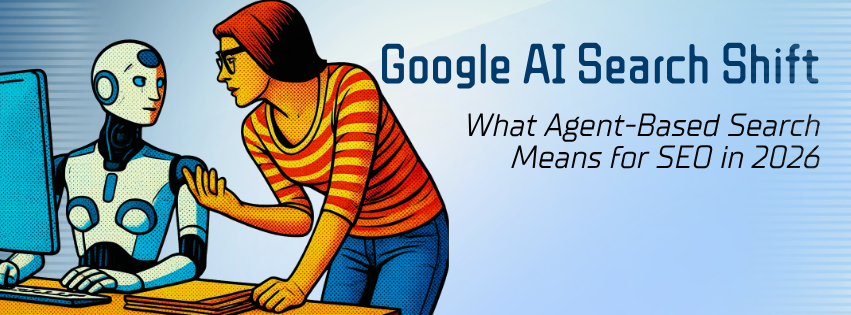
The biggest takeaway is the shift from traditional search results to what Pichai calls an “agent manager” model. In simple terms, search is moving away from serving lists of links and toward actually completing tasks for users.
Instead of searching, clicking, comparing, and converting, users will increasingly rely on AI-driven systems to handle the entire process. Whether it’s booking a service, researching a product, or making a purchase, search engines are becoming execution tools—not just discovery platforms. For anyone in SEO, this fundamentally changes the game. Ranking is no longer the end goal—being usable by the system is.
An Agent-Based Search Timeline That Actually Matters
One of the more important insights is the timeline. Pichai pointed to 2027 as a major inflection point, particularly for non-technical workflows becoming fully automated through AI agents.
That gives businesses a relatively short runway. What we’re seeing now—AI Overviews, longer queries, and conversational search—is just the early phase. The real shift happens when these systems become reliable enough to act independently. From a strategy standpoint, this means the changes we’re seeing today aren’t temporary—they’re foundational.
The Real Bottleneck Isn’t Technology
Interestingly, the biggest limitation isn’t AI capability—it’s adoption.
There’s a gap between what AI can already do and how businesses are actually using it. This comes down to a few practical challenges:
- Teams don’t yet know how to effectively prompt or interact with AI
- Internal data is often siloed or inaccessible
- Systems like CRMs and inventory tools aren’t integrated
- Organizational structures haven’t adapted to AI workflows
Even Google is dealing with these same issues internally. That tells me this transition will be uneven, and companies that adapt faster will gain a serious edge.
Infrastructure Will Slow (But Not Stop) Progress
Another key point is that scaling AI isn’t easy. Google is investing heavily in infrastructure, but there are real-world constraints—things like memory supply, chip production, and data center expansion.
While these factors may slow down how quickly new features roll out, they won’t change the direction. In fact, they’ll likely push companies like Google to make their systems more efficient, which ultimately accelerates long-term adoption.
What This Agent-Based Search Means for SEO Strategy
This is where things get very real for business owners and marketers. In a traditional SEO model, success meant ranking on page one. In an agent-driven model, success means being selected by the system to complete a task.
That selection depends on:
- Structured, machine-readable data
- Accurate and up-to-date business information
- Strong review signals and reputation
- Integration with booking, purchasing, or inventory systems
If your website hides key information, lacks structured data, or creates friction, it simply won’t be used by these systems. Think about it this way: if an AI agent is booking a service or recommending a product, it will choose the business that is easiest to understand and transact with—not necessarily the one with the best-designed website.
The Growing Measurement Problem
One area where I remain cautious is measurement.
Google continues to position AI search as “expansionary,” meaning more searches overall. But more searches doesn’t necessarily translate to more traffic for individual websites.
We’re already seeing a rise in zero-click searches, and that trend will likely accelerate. If AI systems can answer questions or complete tasks without sending users to your site, your visibility may increase while your traffic declines. Until companies like Google provide clearer data on outbound clicks and attribution, businesses need to rely on their own analytics—not just platform narratives.
How Google’s Agent-Based Search Will Impact SEO in 2026
The direction is clear: search is becoming a system that does, not just one that shows. For business owners, this means SEO is no longer just about content and rankings. It’s about infrastructure, data accessibility, and integration. The companies that win will be the ones that make their information easy for machines to interpret and act on. We’re not fully there yet—but based on everything shared in this interview, we’re closer than most people think. And if 2027 really is the tipping point, the time to adapt isn’t later—it’s now.